
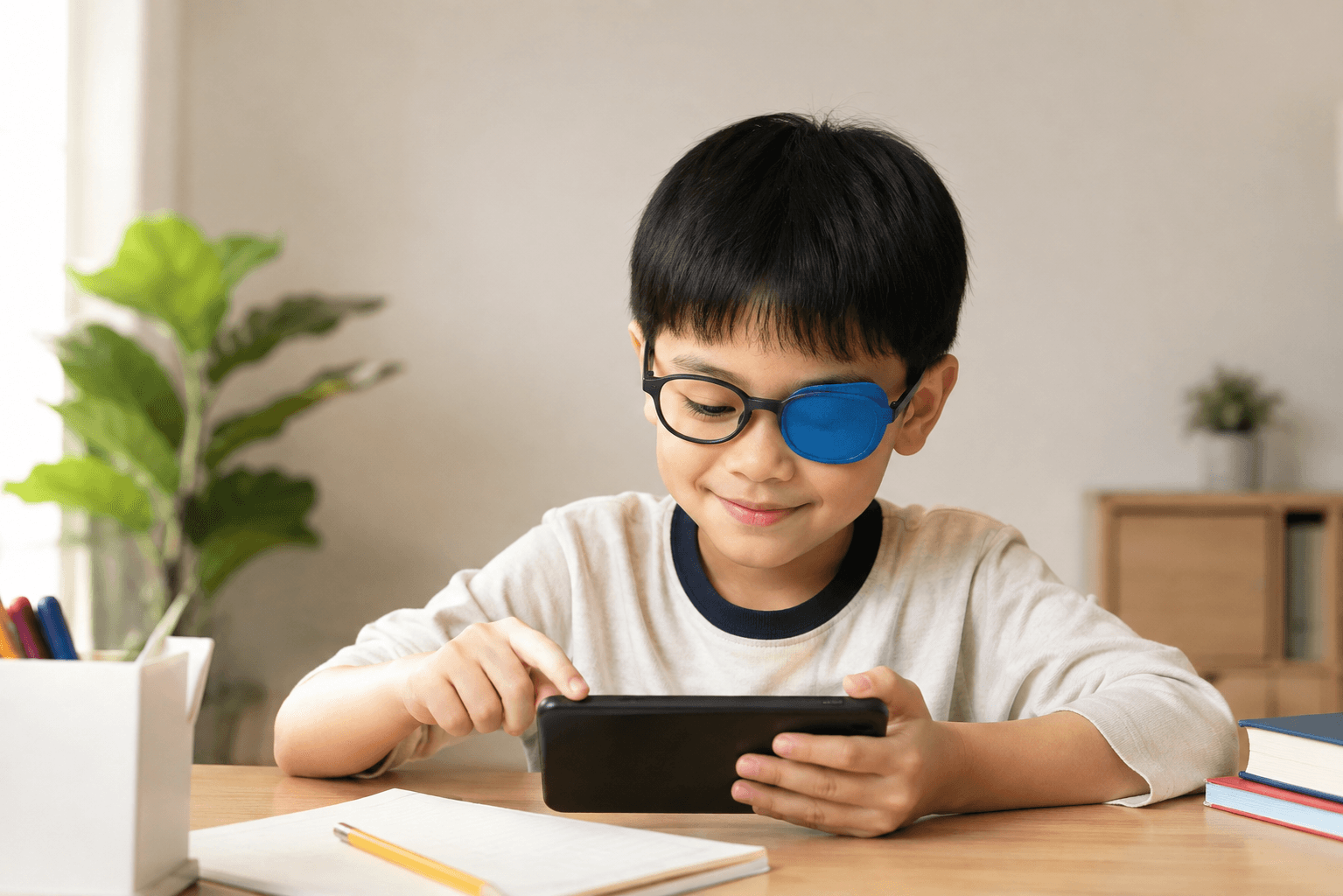
If you have ever had to guide a child through tedious clinical exercises, or if you have struggled as a self-conscious adult to maintain your own visual therapy schedule, you know that traditional approaches to vision care can feel incredibly taxing. Fortunately, the emergence of game-based vision therapy in 2026 has completely changed this dynamic. We are witnessing a monumental shift in how visual processing is trained, transitioning away from tedious clinical exercises toward highly immersive, automated digital experiences.
For decades, correcting Amblyopia (commonly known as lazy eye) meant dealing with boring, repetitive visual drills. These methods often felt like an arduous daily chore, leading to high rates of frustration and therapy abandonment.
Today, the integration of clinical ophthalmology with interactive game design and adaptive artificial intelligence (AI) has solved this historical bottleneck. When treatment is inherently fun, it ceases to feel like a clinical burden, opening the door to superior visual recovery. To explore where this scientific shift fits within the broader spectrum of modern visual care, view our guide on how lazy eye can be treated without surgery in 2026.
The Neuroscience of Gamified Dichoptic Therapy: Rebuilding Brain Pathways
To understand why a game is such an effective clinical tool, we must look at the underlying biology of the human visual system. Lazy eye is fundamentally a neurological communication breakdown. When the brain’s visual cortex receives unbalanced visual signals from the two eyes, it actively ignores the input from the weaker eye to avoid double vision. This defense mechanism is known as monocular suppression.
Historically, clinical attempts to break suppression relied on passive, repetitive eye exercises. However, neurological research shows that the human brain does not learn efficiently when it is bored. Passive viewing fails to stimulate the visual cortex deeply enough to forge new neural pathways.
[Tedious Visual Drills] —> Low Dopamine Release —> Slow/No Neural Adaptation
[Immersive Video Games] —> High Dopamine Release —> Fast Neuroplastic Growth (Rebuilt Pathways)
In contrast, interactive gaming acts as a powerful catalyst for neuroplasticity—the brain’s natural ability to reorganize itself and build new connections. When a patient plays a visually rich digital game, their brain releases neurotransmitters like dopamine. Dopamine acts as a biological “save” button, reinforcing new neural pathways and accelerating learning.
Furthermore, digital games utilize a specialized setup known as dichoptic viewing. Both eyes remain open, but the screen displays different elements to each eye. The stronger eye receives a dimmed, lower-contrast image, while the weaker eye is presented with a bright, high-contrast image.
Because the game requires split-second cognitive decision-making to win, the visual cortex is forced to combine both visual streams in real-time. This active binocular coordination trains the brain to stop suppressing the lazy eye and begin fusing the two inputs into a unified, three-dimensional image.
Gamification is Not Just for Children: Retraining the Adult Visual Brain
A common misconception is that game-based vision therapy is exclusively designed for young children. Many adults assume that because their visual systems are mature, they are either past the point of improvement or would find digital games unappealing.
In reality, adult brains are highly responsive to advanced, cognitively demanding game mechanics. Complex video games require rapid spatial tracking, quick hand-eye coordination, and split-second depth calculations. These are precisely the high-level cognitive tasks required to stimulate adult neuroplasticity and wake up dormant visual pathways.
====================================================================
HOW GAMES STIMULATE ADULT NEUROPLASTICITY
====================================================================
* Spatial Tracking: Forces the visual cortex to calculate target positions.
* Hand-Eye Coordination: Syncs motor control with real-time visual inputs.
* Cognitive Demand: Keeps mature visual pathways active and adaptable.
====================================================================
Furthermore, adults bring a high degree of focused intent to digital gameplay, making their therapy sessions incredibly efficient. Instead of dealing with the social awkwardness and visual discomfort of traditional methods, adults can engage with sophisticated, clinically designed games that feel like a relaxing brain-training routine rather than a medical chore.
To learn more about how mature brains adapt to these advanced visual stimuli without the need for invasive measures, read our detailed analysis of whether adults can fix lazy eye without surgery or if it’s too late after childhood.
The Active Game vs. The Passive Patch: Why Dichoptic Play Wins
For nearly a century, eye patching was the undisputed standard for treating a lazy eye. However, patching is a monocular approach—it physically covers the dominant eye to force the weaker eye to work harder.
While this may improve the visual clarity of the lazy eye in isolation, patching does nothing to teach the two eyes how to coordinate as a team. The moment the patch is removed, the brain often reverts to suppressing the weaker eye because it never learned the skill of binocular fusion.
[Traditional Patching] [Modern Game-Based Therapy]
– Active eye is blocked completely – Both eyes remain active and open
– Monocular (One-sided training) – Binocular (Teaches eyes to work as a team)
– High risk of visual regression – Stable, long-lasting visual alignment
– Induces sensory deprivation – Restores binocular fusion and depth
Playing a contrast-balanced digital game offers a highly comfortable and effective alternative to physical patching. By keeping both eyes open and active, dichoptic gaming trains the visual cortex under natural, everyday binocular conditions.
Instead of suffering through the sensory deprivation and frustration of a patch, patients use color-filtered or polarized glasses to play games that naturally encourage the brain to coordinate both eyes. This active training builds strong depth perception and ensures that the visual gains achieved during therapy are highly stable and permanent.
Explore this clinical comparison further in our detailed evaluation of whether patching is still the best lazy eye treatment or if digital therapies are better in 2026.
The Role of Artificial Intelligence: Dynamic, Strain-Free Personalization
While gamification makes vision therapy fun, artificial intelligence (AI) is what makes it a highly precise medical treatment. A static digital game cannot account for the subtle, daily fluctuations in a patient’s visual coordination. AI solves this by acting as an invisible, real-time clinical guide.
During a session of AI-powered vision therapy, smart software continuously tracks performance metrics, such as:
- The speed at which the patient can visually track moving targets.
- The accuracy of spatial alignment during interactive tasks.
- The patient’s reaction time across different regions of their visual field.
If the AI detects that the patient is tracking targets easily, it automatically scales up the difficulty—slightly increasing target speed or narrowing the contrast differences between the two eyes to keep driving neuroplasticity.
Conversely, if the AI detects visual fatigue, slower reaction times, or muscle strain, it immediately scales back the difficulty. This prevents eye strain, headaches, and cognitive frustration, keeping the therapy session comfortable and highly productive.
This dynamic, automated customization completely eliminates clinical overhead. Patients receive a highly personalized, medical-grade therapy session at home, without requiring constant manual adjustments or frequent clinic visits.
Turning Play into Compliance: Overcoming the Therapy Drop-Out Crisis
The single greatest hurdle to successful vision rehabilitation has never been the quality of the science—it has been compliance. Traditional home exercises fail because they are incredibly boring and tedious. When patients dread their therapy sessions, compliance drops, leading to incomplete treatments and visual regression.
Gamified therapeutics naturally resolve this compliance crisis. When a daily 30-minute session is structured as an engaging digital game, the therapy shifts from a daily struggle into a highly anticipated hobby.
[Boring Traditional Drills] —> Low Compliance —> Missed Sessions —> Treatment Failure
[Engaging AI-Powered Games] —> High Compliance —> Daily Habits —> Lasting Visual Success
Consistent, daily stimulation is vital for the visual cortex to build stable, permanent neural connections. By transforming clinical exercises into immersive play, digital platforms ensure that patients complete their treatment plans, securing faster visual improvements and preventing the risk of relapse.
Discover why consistency and proper methods are critical to avoiding setbacks in our diagnostic guide on why lazy eye treatment fails for some patients: compliance, wrong timing, or wrong method.
Bynocs: Clinical Vision Science Under the Guise of Play
At Bynocs (BYNOCS), we have harnessed the intersection of clinical science, gamification, and artificial intelligence to design a modern path to visual recovery. We specialize in turning rigorous, research-backed visual exercises into highly engaging, interactive digital games.
Rather than relying on outdated, monocular methods or physical patches, Bynocs uses proprietary, contrast-balanced software to train both eyes to work together as a synchronized team. Our adaptive AI system operates seamlessly in the background of every game, monitoring visual responses and dynamically scaling target speeds, contrast levels, and difficulties in real-time.
By providing a comfortable, stress-free, and highly convenient visual path from the comfort of your personal computer, Bynocs offers a highly effective home-based eye therapy that fits effortlessly into any daily routine.
Conclusion & Next Steps
In 2026, managing a lazy eye does not have to feel like a daily burden. By shifting our focus away from tedious, physical eye exercises and embracing the scientific power of play, we can achieve remarkable visual results comfortably and effectively.
Through the integration of AI-driven games and dichoptic training, we can retrain the brain’s visual cortex, break down monocular suppression, and build lasting depth perception—all while having fun.
Don’t let outdated, tedious methods stand in the way of healthy vision. Take your first step toward an engaging, non-invasive visual recovery by scheduling a consultation with a vision specialist today to explore a customized, game-based therapy plan.
Frequently Asked Questions (FAQs)
Can computer games actually improve eye coordination and lazy eye?
Yes, absolutely. When computer games are clinically designed using dichoptic principles, they present different visual data to each eye. This forces the brain’s visual cortex to actively coordinate inputs from both eyes simultaneously, breaking suppression and building strong eye coordination.
How do AI-powered vision therapy games prevent eye strain?
The AI algorithms monitor performance metrics in real-time. If the system detects signs of eye strain or fatigue (such as slower reaction times or decreased tracking accuracy), it instantly adjusts contrast levels, target speeds, and difficulty parameters to ensure a comfortable and safe experience.
Is game-based vision therapy effective for adults who don’t play video games?
Yes. The games designed for vision therapy do not require prior gaming experience. They utilize simple, intuitive controls and are designed to be accessible to individuals of all ages and technical backgrounds, focusing purely on stimulating visual pathways.
How long does a gamified eye therapy session take daily?
A typical gamified therapy session requires only a brief commitment of 20 to 30 minutes a day. Because the software is highly personalized and adaptive, these short sessions are highly efficient, making it easy to build a consistent daily habit.