
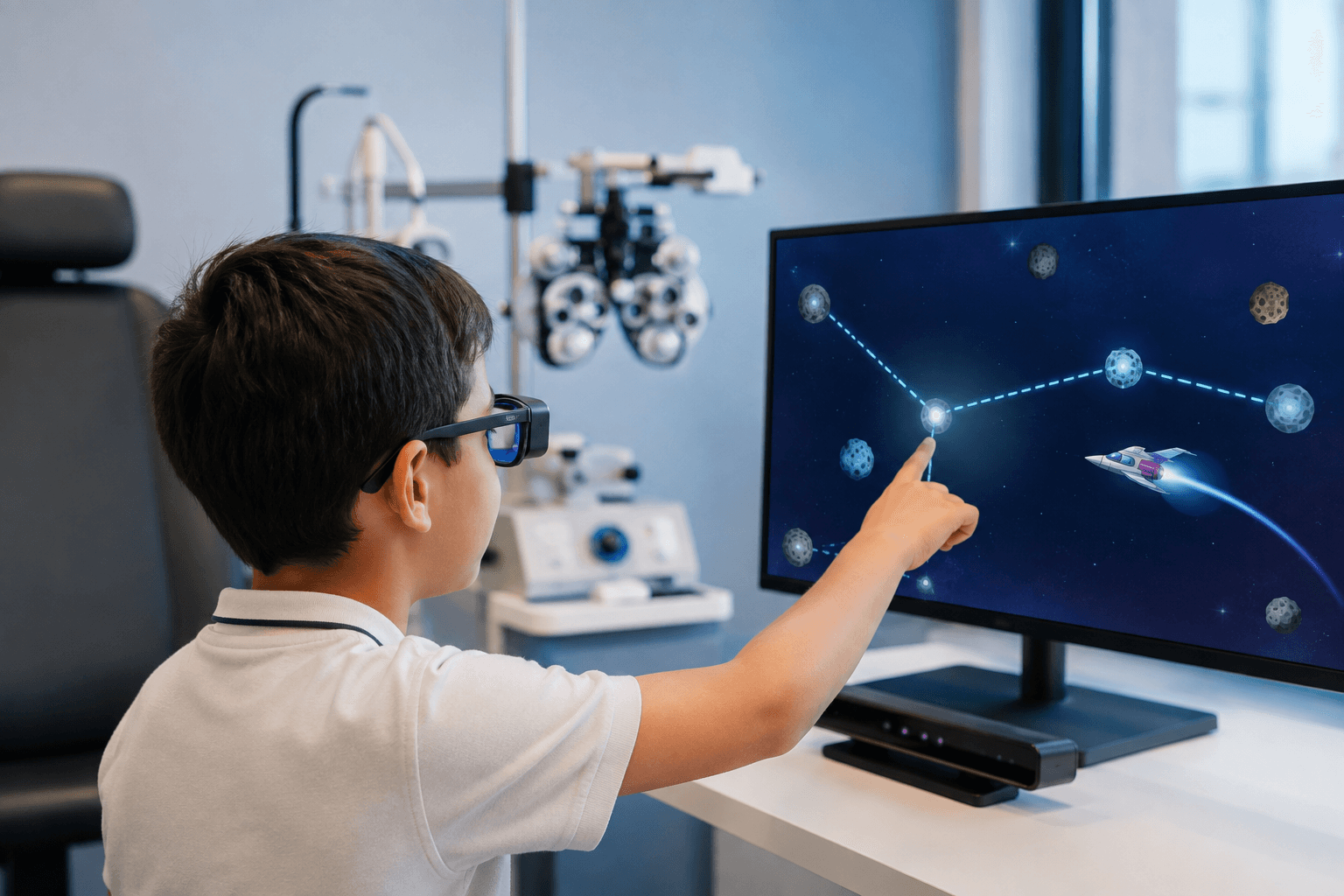
If your child has been diagnosed with a functional vision problem, your optometrist has likely recommended a course of Optometric Vision Therapy. For decades, vision therapy has been the gold standard for treating complex binocular vision disorders that standard eyeglasses simply cannot fix.
However, historically, there was one major hurdle with traditional vision therapy: getting a child to actually want to do it. Standard therapy often involved repetitive exercises using reading charts, physical prisms, and string exercises. For a child already frustrated by visual struggles, adding repetitive medical drills to their daily routine was a recipe for resistance.
Today, that landscape has completely transformed. Thanks to rapid advancements in medical technology, eye doctors are now utilizing Gamified Vision Therapy. By merging clinical rehabilitation with virtual reality (VR), interactive touchscreen boards, and video games, doctors are seeing faster recovery times and unprecedented patient engagement.
But how exactly does playing a video game fix a child’s vision?
To understand the sheer magnitude of why this treatment is so important, we recommend reading our foundational guide on [Internal Link: How Vision Problems Affect Learning, Reading, and Daily Life in Children]. In this article, we will focus specifically on the revolutionary mechanics of gamified treatment, how it utilizes neuroplasticity, and why it is the ultimate tool for helping your child thrive.
What is Optometric Vision Therapy?
Before diving into the games, we must define the medical foundation of the treatment. Vision therapy is essentially physical therapy for the brain and the eyes.
Many parents are confused when therapy is recommended because their child recently passed a school eye chart test. But 20/20 vision only measures clarity at a distance. True functional vision involves a complex network of skills, including eye teaming (binocularity), eye tracking (oculomotor control), and focusing (accommodation).
If you are confused about how your child can have 20/20 vision but still need therapy, uncover the truth in our article: [Internal Link: Why Some Children Struggle to Focus Despite Normal Vision].
Vision therapy does not aim to make the eyes “stronger.” The eye muscles are usually plenty strong. Instead, therapy relies on neuroplasticity—the brain’s incredible ability to adapt, reorganize, and form new neural connections. Vision therapy retrains the neurological pathways between the brain and the eyes so they can communicate seamlessly as a team.
The Mechanics: How Gamified Vision Therapy Works
Gamified vision therapy takes the proven neurological exercises of traditional therapy and embeds them into highly engaging, digital environments. Instead of following a swinging ball on a string, a child might be popping virtual bubbles in space or navigating a digital maze.
Here are the primary technologies utilized in modern gamified vision therapy:
1. Virtual Reality (VR) and Dichoptic Training
One of the most powerful tools in gamified therapy is the VR headset. When a child puts on a specialized clinical VR headset, the doctor can control exactly what each individual eye sees.
In a traditional setting, a child with a “lazy eye” (amblyopia) or an eye turn (strabismus) might have to wear an eye patch. In VR, the doctor uses dichoptic training. The game presents certain essential elements of the game (like a spaceship) to the weaker eye, and other elements (like the incoming asteroids) to the stronger eye. To successfully play the game, the child’s brain is forced to stop suppressing the weaker eye and use both eyes together in a 3D space.
2. Interactive Touchscreen Boards (Sanet Vision Integrator)
Many clinics utilize large, 50-inch interactive touchscreens. Children stand in front of the board and must tap moving targets, follow specific sequences of letters, or track shifting lights. These gamified activities aggressively improve hand-eye coordination, peripheral awareness, and visual reaction times.
3. Computerized Eye-Tracking Software
Using specialized sensors, modern software can track a child’s eye movements down to the millimeter while they play customized games on a computer monitor. The software constantly adjusts the difficulty of the game in real-time. If the child’s eyes start to lose alignment, the game gently prompts them to refocus, providing immediate biofeedback to the brain.
Building Visual Stamina to Combat Eye Fatigue
One of the greatest benefits of gamified vision therapy is its ability to build visual endurance. In today’s digital classroom, a child’s visual system is constantly under intense near-point stress, leading to severe asthenopia, or eye fatigue.
When a child’s eyes are exhausted from trying to stay aligned, they experience headaches, burning eyes, and a complete lack of attention. Gamified vision therapy directly targets the focusing muscles (ciliary muscles) and the convergence systems, teaching them to engage and relax efficiently. Because the child is having fun playing a game, they are willing to sustain visual effort for longer periods. Over a few weeks, this translates to massive improvements in their visual stamina during school hours.
Are digital devices and reading assignments causing your child physical discomfort? Learn how to protect them in our guide: [Internal Link: Is Eye Fatigue Affecting Your Child’s Learning?]
Fixing the Root Cause of Academic Struggles
When a child plays these therapeutic games, they aren’t just achieving high scores—they are actively curing the visual deficits that cause them to struggle in the classroom.
Consider the common signs of visual dysfunction, such as skipping lines of text, using a finger to track words, or having terrible reading comprehension. These issues stem from poor oculomotor (tracking) skills.
During gamified therapy, a child might play a game where they must visually follow a rapidly moving digital target through a maze without moving their head. As they master this game, their eyes learn to make smooth, accurate, and precise jumps (saccades). When they return to their classroom to read a book, those erratic eye movements are gone. They can finally track across a line of text smoothly, which instantly improves their reading speed and comprehension.
If you want to know exactly which classroom behaviors indicate a visual tracking or teaming issue, read our comprehensive checklist: [Internal Link: Signs Vision Problems Are Affecting School Performance].
Why Doctors and Parents Prefer Gamification
The shift toward gamification is not just a gimmick to keep kids entertained; it provides profound clinical advantages for doctors and parents alike:
- Unmatched Patient Compliance: Therapy only works if the patient does the work. When therapy is disguised as an interactive video game, resistance vanishes. Children look forward to their appointments and willingly complete their at-home maintenance exercises.
- Real-Time Data and Biofeedback: Traditional therapy required the doctor to visually observe the child’s eyes and ask subjective questions (“Does this look single or double?”). Gamified software tracks eye position, reaction time, and accuracy objectively. The doctor receives precise data graphs, allowing them to tweak the prescription of the therapy perfectly.
- Faster Neurological Adaptation: Because gamified systems provide instantaneous auditory and visual rewards (like earning points or hearing a celebratory sound when the eyes align properly), the brain’s reward center is activated. This dopamine release actually speeds up the neuroplasticity process, helping new neural pathways lock in faster.
Conclusion: Turning Treatment into Triumph
Discovering that your child has a functional vision problem can feel overwhelming, but the treatment journey doesn’t have to be a battle. Gamified vision therapy has revolutionized pediatric eye care by transforming a difficult neurological rehabilitation process into an engaging, interactive, and highly effective experience.
By leveraging virtual reality, computerized tracking, and the incredible power of neuroplasticity, eye doctors can now help children overcome their academic hurdles faster than ever before. If your child is struggling in school, complaining of eye strain, or unable to focus, a comprehensive binocular vision exam is your first step. Through the power of play, gamified vision therapy can restore their visual skills, alleviate their frustration, and empower them to succeed in the classroom and beyond.
Frequently Asked Questions (FAQs)
What is gamified vision therapy?
Gamified vision therapy is a modernized, doctor-supervised treatment program that uses video games, virtual reality (VR), and interactive digital touchscreens to treat functional visual problems. It makes neurological eye exercises engaging and fun for children, resulting in faster and more effective treatment.
Does virtual reality vision therapy work for lazy eye?
Yes. VR therapy is highly effective for amblyopia (lazy eye). By using dichoptic training, the VR headset presents different images to each eye, forcing the brain to stop suppressing the weaker eye and encouraging both eyes to work together as a 3D team, often eliminating the need for traditional eye patching.
How long does a gamified vision therapy program take?
While every child’s diagnosis is different, most programs last between 12 to 36 weeks. Treatment usually involves one in-office session per week utilizing advanced clinical equipment, paired with 15 minutes of prescribed digital or physical exercises to be completed at home daily.
Is gamified vision therapy covered by medical insurance?
Coverage varies significantly depending on your specific health insurance provider and plan. While vision therapy is a medical treatment (not routine eye care), some providers cover the evaluation and a portion of the therapy, while others consider it an out-of-pocket educational or developmental expense. Always verify directly with your clinic and insurance provider.