
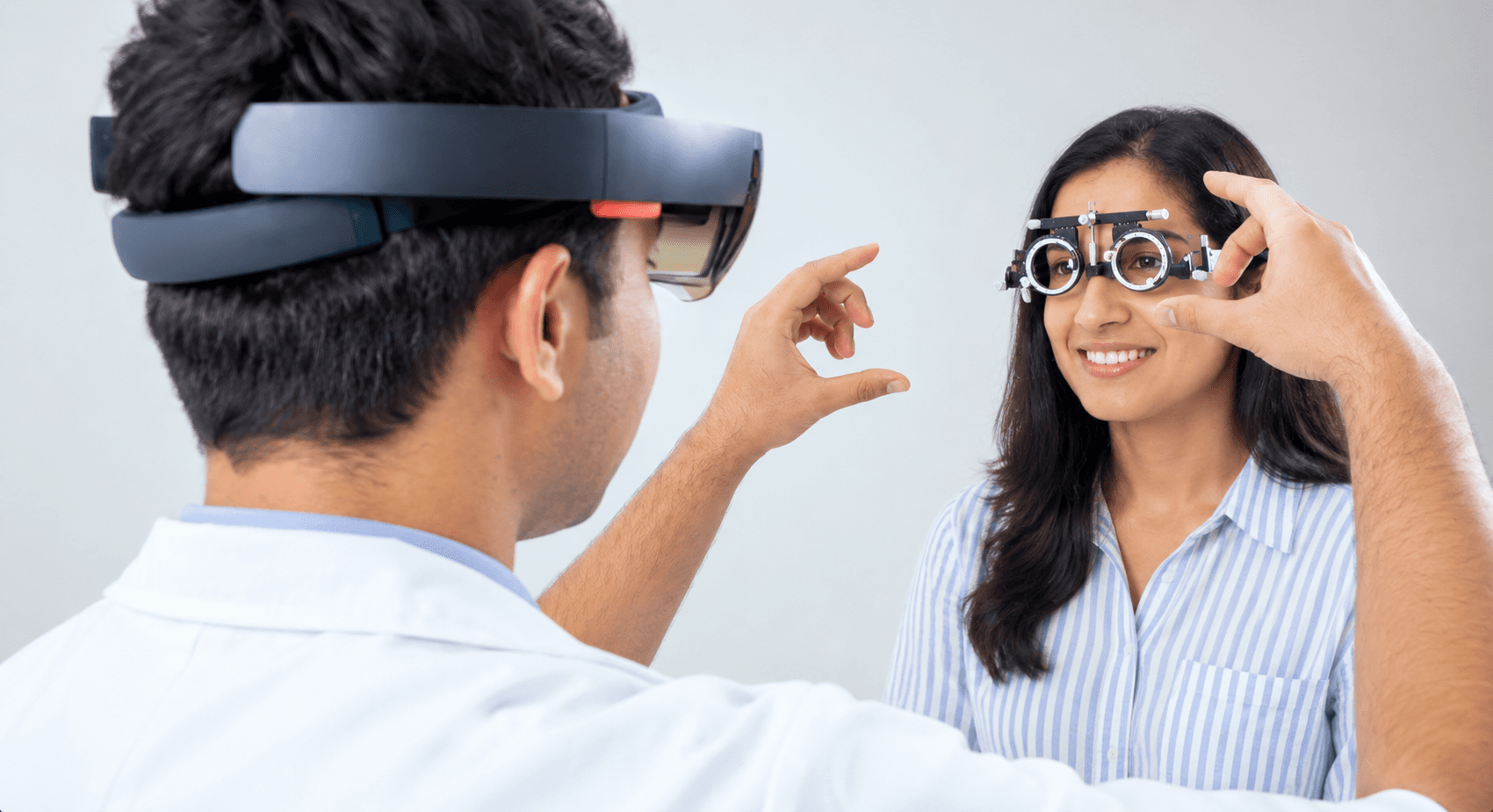
In today’s screen-heavy world, experiencing end-of-day visual fatigue, blurred text, and tension headaches has become a common frustration. These discomforts are key digital eye strain symptoms that signal when our visual system is struggling to keep pace with modern digital demands. To find relief, many people turn to simple, familiar remedies such as taking periodic screen breaks, practicing pencil push-ups, or following online eye exercise guides.
While manual routines offer a convenient starting point for mild discomfort, individuals with persistent functional vision issues often wonder why basic drills fall short. This has led to growing interest in technology-guided options, frequently referred to in modern eye care as “VR-based vision therapy” or digital eye exercises.
Understanding the differences between static home exercises and clinician-directed digital platforms can help you make an informed decision about your visual health and discover effective, long-term options for digital eye strain treatment.
What Are Traditional Eye Exercises?
Traditional eye exercises refer to non-digital, manual routines performed to stretch, relax, or train the extraocular and ciliary (focusing) muscles. These routines have been recommended for decades as self-care habits or auxiliary orthoptic drills.
Common Examples of Traditional Exercises:
- The 20-20-20 Rule: Pausing every 20 minutes to look at an object at least 20 feet away for 20 seconds to relax the eye’s internal focusing lens.
- Pencil Push-Ups: Holding a pencil at arm’s length and slowly bringing it toward the tip of the nose while maintaining a single, clear image to exercise convergence.
- Focus Shifting: Alternating focus between a close-up target (like a thumb) and a distant object to build accommodative flexibility.
- Palming: Cupping warm hands over closed eyes to provide sensory rest and reduce superficial eye tension.
How They Work and Their Limitations
Traditional exercises rely entirely on manual effort and unassisted spatial judgment. While they are useful for basic muscle relaxation and temporary fatigue relief, they have distinct limitations:
- Lack of Dynamic Feedback: Without diagnostic equipment, it is nearly impossible to tell if both eyes are working equally or if one eye is suppressing (turning off mentally).
- Monotonous and Unstructured: Manual repetition can lead to poor compliance and inconsistent technique.
- Inability to Adapt Dynamically: Static physical targets do not automatically adjust contrast, speed, or depth based on real-time visual progress.
What Is Tech-Guided / Digital Vision Therapy?
Tech-guided digital vision therapy represents the modern evolution of functional orthoptic care. Instead of static targets, these programs utilize interactive software, specialized optical eyewear, or virtual reality (VR) displays to deliver targeted visual stimuli.
Rather than offering a generic workout, clinician-directed platforms such as BYNOCS DeStrain use advanced visual algorithms to engage both eyes simultaneously under controlled clinical conditions.
┌─────────────────────────────────────────────────────────────────────────┐
│ HOW DIGITAL THERAPY WORKS │
├─────────────────────────────────────────────────────────────────────────┤
│ │
│ ┌─────────────────────────┐ ┌───────────────────────────┐ │
│ │ Left Eye Target │ │ Right Eye Target │ │
│ │ (e.g., Red Filter Target)│ │(e.g., Cyan Filter Target) │ │
│ └───────────┬─────────────┘ └─────────────┬─────────────┘ │
│ │ │ │
│ └───────────────────┬─────────────────────┘ │
│ ▼ │
│ ┌───────────────────────────────────┐ │
│ │ Brain Integrates Visual Signals │ │
│ │ (Dichoptic Binocular Fusion) │ │
│ └───────────────────────────────────┘ │
│ │
└─────────────────────────────────────────────────────────────────────────┘
Core Features of Tech-Guided Platforms:
- Dichoptic Engagement: Presenting unique visual cues to each eye at the same time, forcing the visual cortex in the brain to integrate signals from both eyes actively.
- Adaptive Challenge Levels: Software automatically scales contrast, object speed, and target distance in response to patient performance.
- Objective Clinical Tracking: Measurements are tracked continuously, giving eye care professionals data to evaluate progress and refine treatment plans.
Key Differences: Traditional Drills vs. Digital Vision Therapy
| Comparison Metric | Traditional Eye Exercises | Digital / VR-Based Vision Therapy |
| Primary Mechanism | Manual, unassisted physical drills | Algorithmic dichoptic software & dynamic visual targets |
| Eye Teaming (Binocularity) | Hard to monitor; risk of single-eye suppression | Actively forces balanced binocular integration |
| Measurement & Data | Subjective self-assessment | Precise, objective tracking of visual metrics |
| Patient Engagement | Repetitive manual routines | Interactive, gamified tasks that improve adherence |
| Clinical Supervision | Often self-directed at home | Directed and calibrated by an eye care professional |
| Target Audience | General screen fatigue & minor rest breaks | Diagnosed binocular deficits, convergence issues, and CVS |
Clarifying Technology: Immersive VR vs. Screen-Based Therapy
When exploring digital eye exercises, terms like “VR eye exercises,” “digital therapy,” and “computerized orthoptics” are frequently used. It is helpful for patients to understand the hardware distinctions:
DIGITAL THERAPY OPTIONS
│
┌─────────────────────┴─────────────────────┐
▼ ▼
IMMERSIVE VR HEADSETS SCREEN-BASED SOFTWARE
(Head-Mounted Displays) (e.g., BYNOCS DeStrain)
│ │
• 360-degree virtual space • Standard computer monitor
• Simulated spatial depth • Specialized anaglyph glasses
• Best for dynamic visual tracking • High comfort, zero headset weight
While head-mounted displays (HMDs) create a 360-degree virtual environment, advanced screen-based software platforms like BYNOCS DeStrain deliver clinician-guided dichoptic exercises on standard computer monitors using lightweight anaglyph glasses.
This screen-based approach provides targeted eye-coordination training without the physical weight or potential motion discomfort of fully enclosed headsets, making it a comfortable, highly accessible choice for addressing computer vision syndrome.
When Are Traditional Exercises Sufficient, and When Is Therapy Needed?
Not every person with tired eyes requires a clinical therapy program. Choosing the right path depends on the underlying cause of your discomfort:
1. General Screen Hygiene & Rest (Traditional Drills)
If your visual discomfort is mild, occurs only after long workdays, and resolves quickly after stepping away from your computer, simple screen hygiene measures are often enough:
- Following the 20-20-20 rule consistently.
- Improving workplace ergonomics and lighting.
- Using over-the-counter lubricating eye drops for superficial dryness.
2. Functional Visual Deficits (Clinician-Directed Therapy)
If you experience persistent digital eye strain symptoms such as double vision, frequent line-skipping while reading, or headaches after short periods of screen work the underlying issue may be a functional binocular defect like convergence insufficiency or accommodative instability.
In these cases, static home drills are rarely enough. A structured, clinician-supervised program helps retrain binocular coordination and focusing stamina at a neurological level.
If you are curious about what happens during a clinical session, read our guide on what happens when you try VR-based vision therapy for the first time.
Explore BYNOCS DeStrain Software Solutions
How Digital Exercises Improve Eye Coordination and Focus
Traditional exercises focus primarily on physical muscle movements. Digital vision therapy, on the other hand, targets the brain-eye connection (neuro-visual processing).
By using dichoptic training, the software presents distinct visual inputs to each eye. The brain is challenged to combine these separate images into a single, cohesive 3D perception. This active stimulation:
- Restores balanced input from both eyes.
- Strengthens convergence and divergence stamina.
- Improves smooth tracking and rapid focus shifting between near and far distances.
To learn more about how tech-assisted exercises improve visual mechanics, explore our detailed analysis on can VR eye exercises improve eye coordination and focus?.
Choosing the Right Approach for Your Vision Care
Before starting any new exercise routine or therapy program, it is essential to consult an optometrist or ophthalmologist. A complete eye exam ensures that your symptoms are not caused by uncorrected refractive errors (like astigmatism), eye infections, or ocular diseases.
When selecting a treatment path, look for clinics that provide thorough diagnostic evaluations and objective progress checks. For practical advice on evaluating providers, read our clinical guide on what you should look for in a clinic offering VR-based vision therapy.
Frequently Asked Questions (FAQs)
1. Are traditional eye exercises effective for digital eye strain?
Traditional exercises like the 20-20-20 rule and palming are helpful for temporary relaxation and easing mild fatigue. However, they cannot correct underlying binocular vision deficits such as convergence insufficiency.
2. Can manual eye exercises cause eye strain if done incorrectly?
Yes. Performing unmonitored drills (like pencil push-ups) with incorrect technique or for too long can over-fatigue focusing muscles, causing mild headaches or transient blurred vision.
3. How does digital vision therapy prevent one eye from doing all the work?
Digital platforms like BYNOCS DeStrain use dichoptic technology with specialized glasses. Key elements of the task are split between the two eyes, requiring the brain to process input from both eyes simultaneously to complete the exercise.
4. Do I need a VR headset to do digital vision therapy?
No. While some clinics use head-mounted displays, many advanced platforms (including BYNOCS DeStrain) run on standard computer monitors paired with specialized anaglyph glasses, providing comfortable and precise visual training.
5. Can I replace my prescription glasses with digital vision therapy?
No. Digital vision therapy trains functional eye muscle coordination and focusing stamina; it does not change the physical shape of your eyeball or replace lenses prescribed for myopia, hyperopia, or astigmatism.
6. How quickly do patients notice results with digital therapy compared to home drills?
Because digital therapy offers calibrated, interactive tasks that actively prevent suppression, many patients see improvements in focusing stamina and screen comfort within a few weeks of structured clinical sessions.
7. Is digital vision therapy suitable for children with screen fatigue?
Yes, when prescribed and monitored by a qualified eye care professional. Gamified software interfaces make sessions engaging for younger patients while maintaining strict clinical control.
8. How does an eye care specialist determine which therapy approach I need?
An optometrist or ophthalmologist conducts a binocular vision evaluation measuring convergence, focusing speed, spatial alignment, and tracking accuracy to determine whether home habits, optical updates, or digital therapy are needed.