
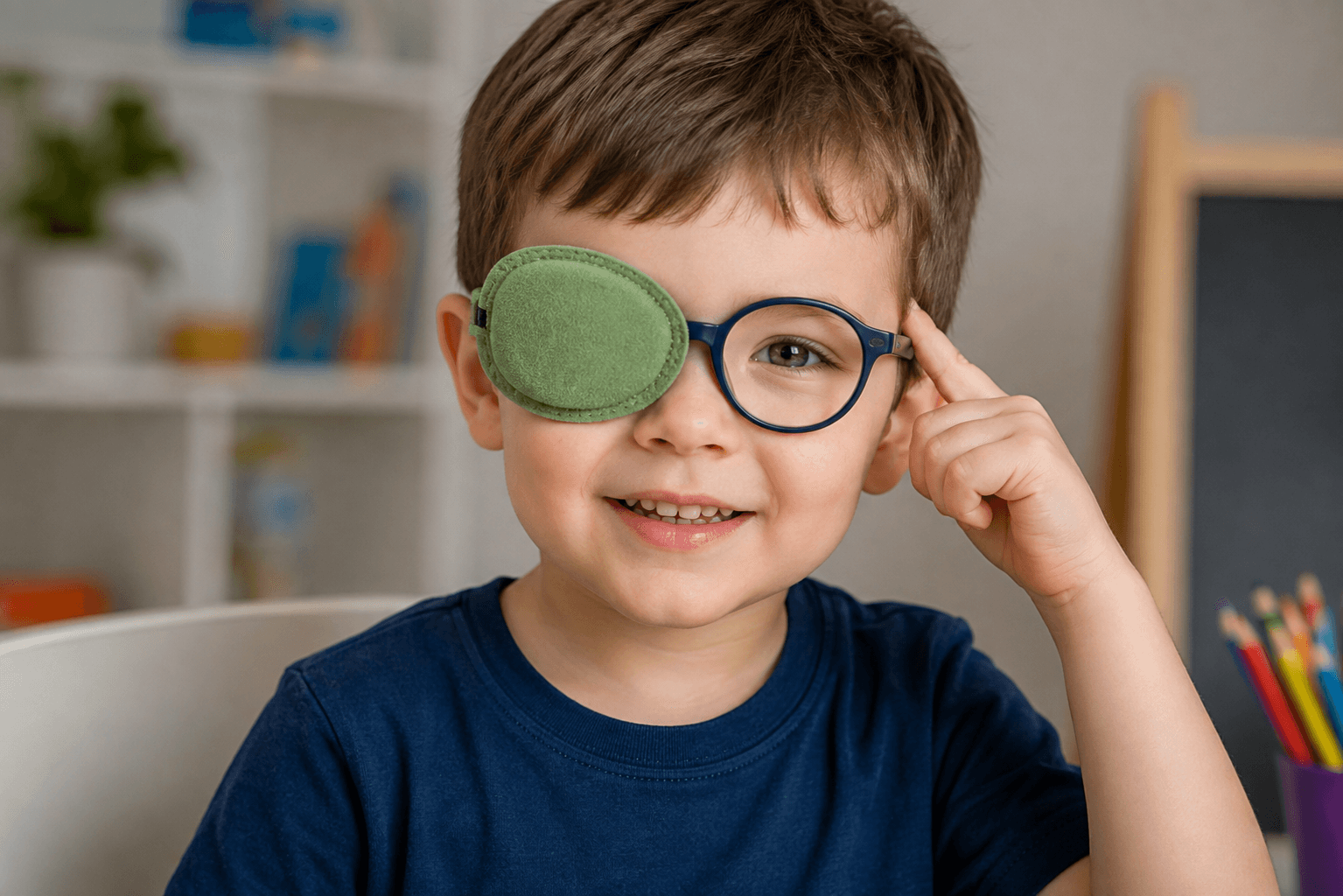
The brain prefers one eye over the other when the two eyes stop sending it images of equal quality. Vision does not happen in the eyes alone it is assembled in the brain. When one eye delivers a blurred, misaligned, or otherwise unreliable signal, the visual system quietly begins leaning on the clearer eye and reducing its use of the weaker one. Over time, that habit can harden into a measurable vision problem.
This is where two ideas often get confused. A mild leading eye is normal and harmless. A brain that has learned to ignore one eye is something else entirely, and it is the reason amblyopia treatment focuses on the brain rather than only on the eye itself. Understanding the difference is one of the first steps in understanding unequal vision and how it affects visual development.
What “Eye Preference” Actually Means
Before looking at causes, it helps to separate two terms that sound similar but describe very different situations.
Normal ocular dominance
Most people have a dominant eye the one the brain leans on slightly when aiming, sighting, or focusing on a single point. You can notice it when looking through a camera viewfinder or a telescope. This kind of preference is completely ordinary. Both eyes still contribute, depth perception stays intact, and no treatment is needed.
When preference turns into suppression
Visual suppression is different. It happens when the brain actively reduces or blocks the input from one eye instead of merging it with the other. The suppressed eye may be healthy and structurally normal, yet the brain does not fully use what it sees. Suppression is the mechanism that underlies amblyopia, commonly called lazy eye.
| Ocular dominance | Visual suppression | |
|---|---|---|
| What it is | A slight preference for one eye | The brain reducing or ignoring one eye’s input |
| Both eyes used? | Yes | Not fully |
| Depth perception | Normal | Reduced or absent |
| Needs treatment? | No | Yes |
How the Brain Normally Merges Two Images Into One
Your eyes sit a few centimetres apart, so each one captures a slightly different view of the world. The visual cortex takes these two pictures and blends them into one a process called fusion. The small differences between the two views are what create stereopsis, the sense of depth that lets you judge how far away a step, a ball, or an oncoming vehicle really is.
This blending only works when both images are clear enough and aligned enough to be matched. When they are not, the brain has a problem to solve and its solution is usually to favour the better signal.
Why the Brain Starts Favouring One Eye
Eye preference is rarely random. It almost always traces back to one of the following causes.
One eye sees less clearly than the other
When there is a meaningful difference in focusing power between the two eyes a condition called anisometropia one eye sends a sharp image while the other sends a soft, blurred one. Rather than combining a clear picture with a fuzzy one, the brain prioritises the sharp signal. Because the child usually still sees well through the stronger eye, nothing feels wrong, and the imbalance goes unnoticed for years. This is explored in more detail in what happens when one eye sees less clearly than the other.
The eyes are not aligned
In strabismus, the eyes point in slightly different directions. Each eye is looking at a different part of the scene, so the brain receives two images that cannot be fused. Left as they are, they would cause double vision. The brain avoids that confusion by suppressing one image an efficient short-term fix with a long-term cost.
Something physically blocked vision early on
Anything that obstructs a clear image during early development can trigger the same response: a congenital cataract, a drooping eyelid, corneal clouding, or even prolonged patching of the stronger eye without balanced follow-up. The brain receives little usable information from that eye and adapts by relying on the other.
The brain adapts because it can
Underlying all of these causes is neuroplasticity. The visual system is highly adaptable while it is developing, which is exactly why an imbalance can shape it so quickly. The same flexibility that allows suppression to take hold is also what makes amblyopia treatment possible, and it is a major reason early vision support matters so much during childhood.
What Long-Term Suppression Does to Vision
When one eye is under-used for years, the effects extend beyond that eye alone:
- Reduced visual acuity in the suppressed eye, even with glasses on
- Weak or absent depth perception, affecting stairs, sports, pouring, and parking
- Reading fatigue and difficulty sustaining close work
- Slower reaction judgement in fast-moving or three-dimensional tasks
- Higher stakes if the stronger eye is injured, since there is no equally capable backup
None of these appear overnight. They accumulate quietly, which is why so many cases are discovered during a routine school screening rather than because someone complained.
Signs the Brain May Be Favouring One Eye
Watch for the following, particularly in children:
- Tilting or turning the head to look at things
- Closing or covering one eye when concentrating
- Squinting in bright light more than expected
- Poor judgement of distance or frequent bumping into objects
- Clumsiness with catching, pouring, or stair climbing
- One eye drifting inward or outward, even occasionally
- Rubbing one eye repeatedly
- Avoiding reading, puzzles, or other close-up tasks
A single sign is not a diagnosis. A pattern of them is a reason to book an eye examination.
How Eye Preference Is Confirmed in a Clinic
Suppression cannot be confirmed at home, because the stronger eye compensates so well that the person feels nothing unusual. An eye care professional looks for it directly using a combination of checks: a cover test and alternate cover test to reveal misalignment and shifting fixation, a side-by-side comparison of visual acuity in each eye, a refraction to detect unequal focusing power, and stereopsis testing to see how well the two eyes are working as a pair.
Together these show not just how each eye performs alone, but how the brain is using them together the detail that actually determines the treatment plan. You can read more about how doctors measure differences between the two eyes.
Can the Brain Be Trained to Use Both Eyes Again?
Yes, in many cases. Modern amblyopia treatment is built on the understanding that the goal is not simply to make the weaker eye stronger, but to restore teamwork between both eyes.
Treatment usually begins with correcting the underlying cause accurate glasses for unequal refractive error, and management of any alignment issue or physical obstruction. Without that, the brain has no reason to change its habit.
From there, binocular approaches give both eyes a task at the same time. Dichoptic training presents slightly different images to each eye so that the brain can only complete the task by using both encouraging fusion rather than penalising the stronger eye. This differs from traditional patching, which blocks the stronger eye entirely.
Perhaps the most significant shift is in expectations for older patients. Amblyopia was long considered untreatable beyond childhood. Current binocular vision therapy approaches have made meaningful improvement possible for teenagers and adults as well, though progress is generally slower than in young children. Across all age groups, consistency matters more than intensity short, regular sessions sustained over weeks tend to outperform occasional long ones.
Frequently Asked Questions
Is having a dominant eye a problem? No. A mild dominant eye is normal and shared by most people. It only becomes a concern when the brain stops using the other eye properly, which reduces visual acuity and depth perception.
Can the brain ignore one eye completely? It can substantially suppress one eye’s input, particularly when images are blurred or misaligned. The eye still sees, but the brain does not fully process what it sends.
Does eye preference always mean lazy eye? No. Ordinary ocular dominance is not amblyopia. Amblyopia involves reduced vision in one eye that persists even with the correct glasses, caused by how the brain processes that eye’s input.
Can adults be treated for a brain preference for one eye? Often, yes. Binocular and dichoptic approaches have shown that adult visual systems retain enough plasticity to respond, although improvement typically takes longer than in children.
How long does it take to rebalance both eyes? It varies with age, severity, and consistency. Improvement is usually measured over weeks and months of regular practice, with periodic clinical reassessment guiding the plan.