
When one eye sees less clearly than the other, the brain does not blend the two images into something in between. It prioritises the sharper picture and gradually relies less on the blurred one. The eye keeps working, but the brain stops giving its signal equal weight.
What makes this pattern so easy to miss is that nothing feels wrong. With both eyes open, the stronger eye covers for the weaker one so completely that vision seems normal. Children in particular rarely mention it, because they have no reference point for what clear vision in both eyes should feel like. Left unaddressed, that quiet imbalance can develop into amblyopia and understanding it early is central to understanding unequal vision and how it shapes visual development.
What “Unequal Vision Between the Eyes” Means
The phrase covers two related but distinct situations, and knowing which one applies changes what happens next.
Unequal focusing power between the eyes
Sometimes each eye simply needs a different prescription. One may be more short-sighted, long-sighted, or astigmatic than the other. When that difference is significant, it is called anisometropia. The eye with the larger uncorrected error delivers a softer, less detailed image to the brain.
Unequal vision even with correction
In other cases, glasses sharpen both eyes on paper, yet one eye still reads fewer lines on the chart. This is reduced best-corrected visual acuity the eye itself is structurally healthy and properly corrected, but the brain is not processing its input fully. This is the situation that defines amblyopia, and it is why amblyopia treatment targets visual processing rather than the eye alone.
| Unequal focusing power | Unequal vision despite correction | |
|---|---|---|
| What it is | Each eye needs a different prescription | One eye still sees less even with correct glasses |
| Where the issue sits | In the eye’s optics | In how the brain uses that eye |
| Typical first step | Accurate glasses or contact lenses | Correction plus binocular treatment |
| Can it resolve with lenses alone? | Often, if caught early | Usually not on its own |
Why One Eye Might See Less Clearly
Unequal vision almost always has an identifiable cause.
A difference in refractive error
This is the most common reason. One eye focuses light accurately while the other does not, so the images arriving at the brain differ in sharpness from the start. Because the difference is present from an early age, it feels entirely normal to the person experiencing it.
Eye misalignment
If one eye points slightly inward or outward, it is not looking at the same point as its partner. The two images cannot be matched, and the brain has to decide which one to trust.
A physical obstruction to light
A congenital cataract, a drooping eyelid, or corneal clouding can block or scatter light entering one eye. Even a partial obstruction during early development is enough to degrade that eye’s contribution.
Injury or eye surface problems
Trauma, corneal scarring, or a persistently irregular tear film can reduce clarity in one eye specifically, without affecting the other.
Important: A sudden change in vision in one eye is different from a gradual, long-standing difference. Sudden blurring, a curtain-like shadow, flashes, or vision loss in one eye needs urgent assessment by an eye doctor not a routine appointment.
How the Brain Reacts to a Blurred Eye
Normally, the visual cortex takes the slightly different views from each eye and fuses them into a single three-dimensional image. Fusion depends on both images being clear enough and aligned enough to be matched.
When one image is persistently blurred, that matching becomes difficult. Instead of struggling to combine a sharp picture with a soft one, the brain leans on the reliable signal. Repeated day after day, that preference becomes a habit, and the habit becomes visual suppression the brain actively reducing the weaker eye’s input. This is the mechanism explained in more detail in why the brain sometimes prefers one eye over the other.
Why the Problem Often Goes Unnoticed
Unequal vision is unusually good at hiding, for three reasons.
First, the stronger eye compensates. With both eyes open, the person sees clearly enough to read, play, and navigate without difficulty.
Second, there are no obvious symptoms. There is no pain, no redness, and often no headache. Nothing prompts a visit to the clinic.
Third, children cannot report what they have never experienced. A child whose left eye has always been blurred assumes everyone sees that way. They are not withholding information they simply have nothing to compare it to.
This is why routine eye examinations and school vision screenings catch far more cases than parents or patients do on their own.
Signs That One Eye May Be Seeing Less Clearly
Watch for these, especially in children:
- Squinting or closing one eye when concentrating
- Tilting or turning the head to view something
- Sitting unusually close to screens or books
- Covering one eye while reading
- Eye strain or headaches after close work
- Difficulty judging distance, or frequent bumping into things
- One eye drifting inward or outward
- Complaints of tiredness in one eye specifically
One sign alone is not a diagnosis. A recurring pattern is a reason to book an eye examination.
What Long-Term Unequal Vision Affects
Living with one under-used eye has effects that go beyond blurred vision on that side:
- Depth perception weakens. Stereopsis depends on both eyes contributing, so stairs, catching, pouring, and parking all become less precise.
- Reading endurance drops. Sustained close work becomes tiring sooner.
- Fast, three-dimensional tasks get harder. Sports and driving both rely on accurate distance judgement.
- The backup is unreliable. If the stronger eye is ever injured or affected by disease, the weaker eye may not be able to take over comfortably.
These changes build slowly rather than announcing themselves, which is exactly why they are so often discovered late.
How the Difference Between the Eyes Is Assessed
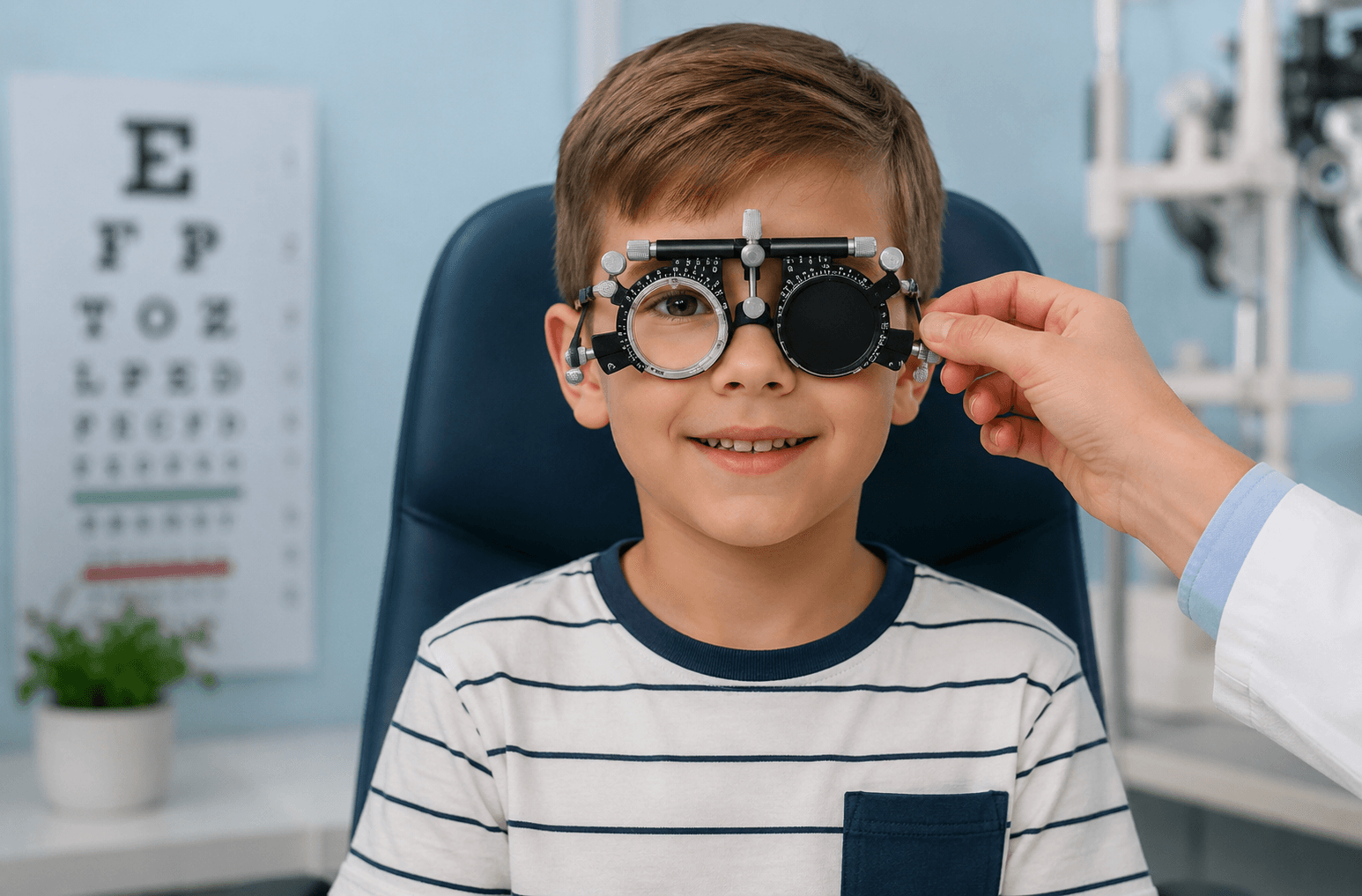
An eye examination checks each eye separately before assessing them as a pair. That means measuring visual acuity one eye at a time, performing a refraction to identify unequal focusing power, checking alignment with cover testing, and testing stereopsis to see how well the two eyes work together.
The key detail is that the difference between the eyes often matters more than either eye’s individual number. Two eyes that each read moderately well can be perfectly healthy; one eye reading noticeably worse than its partner, even when both are corrected, is the finding that changes the plan. A fuller explanation of these checks is covered in how doctors measure differences between the two eyes.
What Can Be Done About It
Management follows a clear sequence.
Correct the optics first. Accurate glasses or contact lenses give both eyes the best possible image. When unequal vision is identified early, correction alone sometimes allows the weaker eye to improve considerably.
Address the underlying cause. If misalignment, a cataract, or a lid position is limiting one eye, that has to be managed before visual processing can be retrained.
Retrain the brain where suppression has developed. If the weaker eye still underperforms despite correct glasses, amblyopia treatment becomes necessary. Modern binocular and dichoptic approaches present slightly different images to each eye so that the task can only be completed using both encouraging the brain to fuse rather than suppress. This differs from traditional patching, which improves the weaker eye by blocking the stronger one but does not directly train the two to work together.
Start as early as possible, but do not assume it is too late. The developing visual system responds fastest, which is why early vision support matters so much during childhood. Binocular approaches have also shown meaningful results in teenagers and adults, though progress is typically slower and demands more consistency.
Frequently Asked Questions
Is it normal for one eye to be weaker than the other? Small differences between the eyes are very common and often harmless. It becomes clinically significant when one eye sees noticeably worse even with the correct glasses, or when depth perception is affected.
Can glasses fix a difference between the two eyes? Often yes, particularly when the difference is purely optical and identified early. If the brain has already begun suppressing the weaker eye, glasses alone are usually not enough.
Why does my child not complain if one eye is blurry? Because the stronger eye compensates and the child has no experience of clearer vision to compare against. This is why regular eye examinations matter more than waiting for symptoms.
Can unequal vision get worse over time? The underlying prescription can change, and prolonged suppression can deepen if untreated. Early correction and monitoring reduce that risk considerably.
At what age should a child’s eyes first be checked? Vision assessments are recommended in early childhood, well before school age, since problems detected earlier respond faster. Ask your eye care professional about the schedule appropriate for your child.