
Unequal vision means one eye sees more clearly than the other, even when both eyes look perfectly healthy. In most cases the difference is not caused by damage to the eye itself it is caused by how the brain learned to process the two images during early childhood. That distinction matters, because it explains why amblyopia treatment works on the visual system as a whole rather than on the eye alone.
This guide explains what unequal vision is, why the brain begins favouring one eye, the early signs parents and adults commonly miss, how eye specialists measure the difference between two eyes, and why timely vision support during childhood shapes long-term visual development.
What Is Unequal Vision?
Unequal vision, known clinically as anisometropia when it involves a difference in refractive power, occurs when the two eyes deliver images of different quality to the brain. One eye may be more short-sighted, long-sighted, or astigmatic than the other. The brain receives one sharp image and one blurred image and has to decide what to do with the mismatch.
When that mismatch continues through the years of visual development, the weaker eye can become amblyopic the condition widely called lazy eye. In amblyopia, the eye is structurally normal, but the visual pathway serving it has never developed full sharpness.
Quick definition: Amblyopia is reduced vision in one eye caused by abnormal visual development in early childhood, not by disease or injury to the eye itself.
Three common pathways lead to it:
- Refractive amblyopia — a significant unequal prescription between the two eyes (anisometropia)
- Strabismic amblyopia — eye misalignment, or strabismus, where the eyes point in different directions
- Deprivation amblyopia — something physically blocking clear vision early in life, such as a congenital cataract or a drooping eyelid (ptosis)
Why Does the Brain Sometimes Prefer One Eye Over the Other?
The visual cortex is built to merge two slightly different images into one three-dimensional picture. When one image arrives blurred or misaligned, merging them would produce blur or double vision. The brain solves the problem by turning down the signal from the weaker eye a process called interocular suppression.
Suppression is efficient in the short term and costly in the long term. The suppressed eye is used less, so the neural connections serving it stay underdeveloped while the dominant eye’s pathways strengthen. Over months and years the imbalance becomes self-reinforcing.
This is also why simply prescribing glasses does not always restore balance on its own. Glasses correct the optics; they do not automatically undo the suppression the brain has already learned. Modern binocular vision therapy approaches target exactly that retraining the brain to accept and use input from both eyes together.
Read more: Why Does the Brain Sometimes Prefer One Eye Over the Other?
What Happens When One Eye Sees Less Clearly Than the Other?
The everyday effects of unequal vision are often subtle, because the stronger eye compensates well enough to pass a casual glance and even a basic school screening where both eyes are tested together.
Common day-to-day effects include:
- Reduced depth perception (stereopsis) difficulty judging distances, catching a ball, pouring liquids, or parking a vehicle
- Slower reading and losing place on the line, especially in longer passages
- Eye strain, headaches, or fatigue during homework, screen time, or close work
- Head tilting, squinting, or closing one eye to get a clearer image
- Clumsiness on stairs, kerbs, or uneven ground
- Avoidance of detailed tasks that demand sustained focus
Children rarely report these symptoms, for a simple reason: unequal vision is all they have ever known. They have no reference point for what “normal” looks like. Adults with long-standing amblyopia often describe the same thing they only discover the difference when the dominant eye is temporarily covered or injured.
Read more: What Happens When One Eye Sees Less Clearly Than the Other?
How Do Doctors Measure Differences Between the Two Eyes?
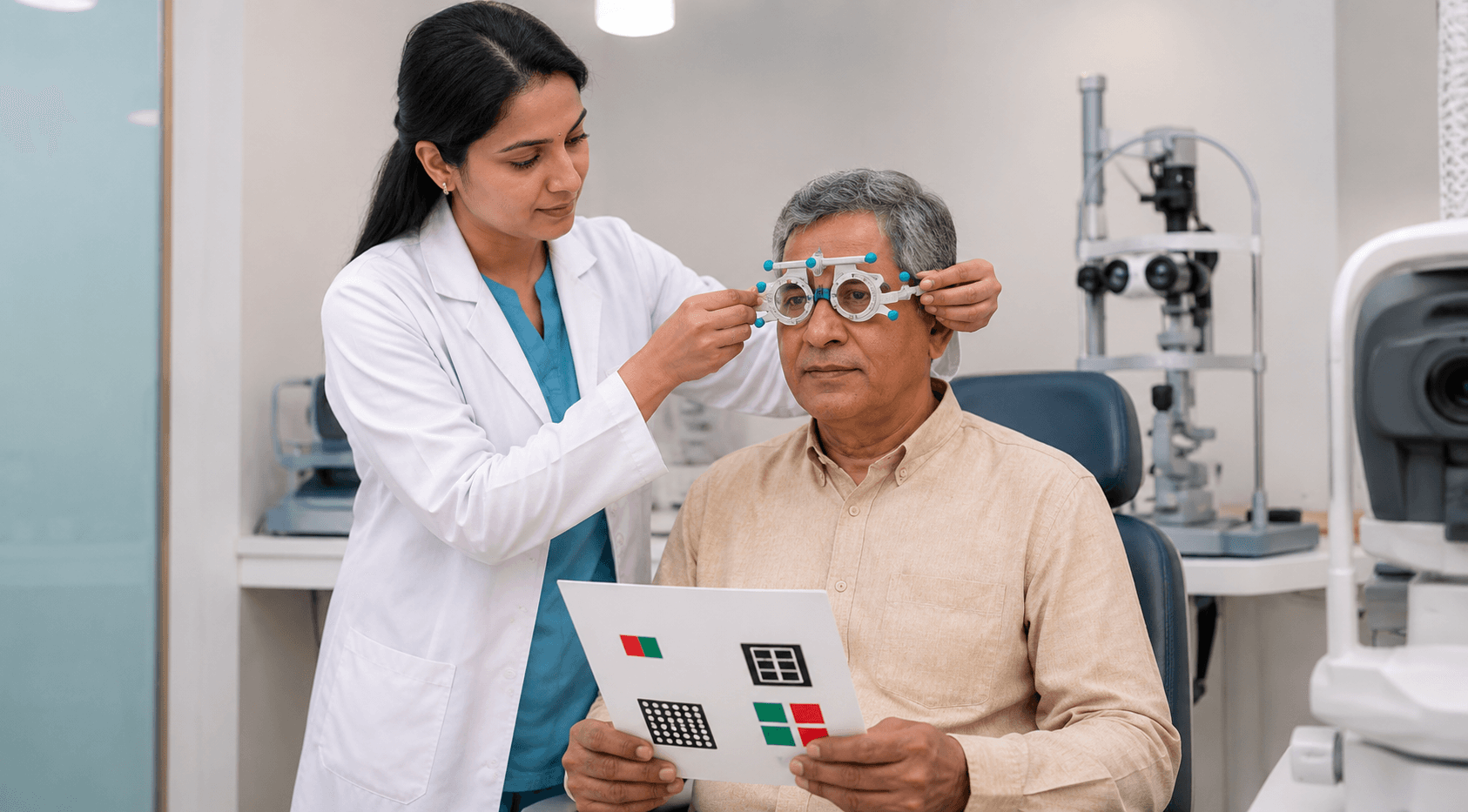
An optometrist or ophthalmologist does not rely on a single test. Diagnosis depends on comparing each eye separately and then assessing how the two work together.
| Test | What it measures |
|---|---|
| Visual acuity (Snellen, LogMAR, HOTV, Lea symbols) | Sharpness of each eye tested individually; picture and matching charts are used for preschool children |
| Cycloplegic refraction | The true prescription of each eye, with focusing muscles temporarily relaxed by drops |
| Cover and alternate cover test | Eye alignment and the presence of strabismus |
| Stereoacuity test (Randot, Titmus) | How well the two eyes work together to produce depth perception |
| Contrast sensitivity | Ability to distinguish subtle shades often reduced in amblyopia even when acuity looks acceptable |
| Dilated fundus and red reflex exam | Rules out cataract, retinal, or optic nerve causes |
A key diagnostic marker is the interocular difference: when one eye reads two or more lines worse than the other on the chart, with no structural explanation, amblyopia is strongly suspected.
This is also why a “both eyes open” school vision screening can miss the condition entirely. The stronger eye carries the test. Each eye needs to be measured on its own.
Read more: How Do Doctors Measure Differences Between the Two Eyes?
Why Early Vision Support Can Matter During Childhood
Visual development is most malleable in the first years of life. During this sensitive period, neural pathways are actively forming, and the brain responds quickly to change in visual input. This is why paediatric eye specialists encourage a first comprehensive eye examination in the preschool years, and earlier if there is a family history of amblyopia, strabismus, or high refractive error.
Earlier detection generally means:
- Fewer months of established suppression to reverse
- Better prospects for restoring depth perception, not just letter-chart sharpness
- Less disruption to reading, sport, and classroom confidence
- A shorter overall treatment course
That said, an important shift has taken place in how the field views age. The older belief that amblyopia becomes untreatable after childhood has been revised. Research into adult neuroplasticity and dichoptic training where each eye is shown a different, balanced image so the brain is encouraged to use both has shown that meaningful improvement remains possible in older children, teenagers, and adults. Early is better; late is no longer considered hopeless.
Read more: Why Early Vision Support Can Matter During Childhood
What Does Amblyopia Treatment Usually Involve?
An eye specialist typically works through a sequence rather than a single intervention:
- Correct the optics first. Full-time spectacle or contact lens correction of the unequal prescription. Vision in the weaker eye often improves over several weeks on glasses alone this is called refractive adaptation.
- Reduce the dominance of the stronger eye. Traditional occlusion therapy (patching) or atropine penalisation drops temporarily blur the dominant eye so the weaker one is forced to work.
- Rebuild binocular teamwork. Binocular and dichoptic approaches present coordinated images to both eyes at once, targeting suppression directly and aiming to restore stereopsis rather than only acuity.
- Treat any underlying cause. Surgical alignment for strabismus, or removal of a visual obstruction such as a congenital cataract, where indicated.
- Monitor and maintain. Follow-up examinations track progress and watch for regression after active treatment ends.
The right combination depends on age, cause, severity, and how the individual responds. Only a qualified eye care professional can determine that after a full examination.
Everyday Habits That Support Healthy Visual Development
- Book a comprehensive eye examination for children before school begins, and repeat it periodically
- Treat squinting, head tilting, or one eye drifting as reasons to get checked, not habits to correct verbally
- Follow the prescribed wearing schedule for glasses and patches consistently inconsistency is the most common reason treatment stalls
- Balance close work with distance breaks; the 20-20-20 approach is an easy rule for children and adults
- Make sure reading and screen areas are well lit and set at a comfortable distance
- Mention family history of lazy eye, squint, or strong prescriptions at every eye appointment
Frequently Asked Questions
What is amblyopia in simple terms? Amblyopia is reduced vision in one eye because the brain has not learned to use that eye properly during early visual development. The eye itself is usually healthy.
What causes one eye to be weaker than the other? The most common causes are a significantly different prescription between the eyes (anisometropia), eye misalignment (strabismus), and anything that blocked clear vision in infancy, such as a congenital cataract.
How do I know if my child has a lazy eye? Watch for head tilting, squinting, closing or covering one eye, poor depth perception, clumsiness, or reluctance to do close work. Because children rarely complain, a separate acuity test for each eye is the only reliable way to confirm it.
Can amblyopia be treated in adults? Improvement is possible in adults, though it usually takes longer than in children. Binocular and dichoptic training approaches that address suppression have made adult treatment a realistic option rather than a lost cause.
Do glasses alone fix unequal vision? Sometimes. Full-time correction can improve acuity in the weaker eye over several weeks. When suppression is well established, additional treatment is usually needed to rebuild binocular function.
At what age should a child have their first eye test? Guidance varies by region, but a comprehensive examination in the preschool years is widely recommended and sooner if there is a family history of amblyopia, squint, or high refractive error.
Is amblyopia the same as strabismus? No. Strabismus is misalignment of the eyes. It is one of the causes of amblyopia, but the two conditions can occur separately.
How long does amblyopia treatment take? It varies widely from a few months to over a year depending on age, cause, severity, and how consistently the treatment plan is followed.